A summary of Aristocrat Technologies Australia Pty Ltd v Commissioner of Patents [2025] FCAFC 131 Full Federal Court of Australia | 16 September 2025
Few patent law questions have generated as much judicial energy in Australia as this one: when is a computer-implemented invention a patentable "manner of manufacture"? After a decade of contested litigation, a delegate's revocation, two primary judge decisions, two Full Federal Court decisions, a divided High Court and a remittal, the Full Federal Court in Aristocrat Technologies Australia Pty Ltd v Commissioner of Patents [2025] FCAFC 131 has finally brought the matter to rest. With the High Court refusing leave to appeal on 5 February 2026, this decision now represents settled Australian law.
The case concerned four innovation patents held by Aristocrat — one of the world's largest electronic gaming machine (EGM) manufacturers — covering a gaming system and method for providing a "feature game". The core legal question was whether the inventions claimed in those patents constituted a "manner of manufacture" within s 18(1A)(a) of the Patents Act 1990 (Cth), which incorporates s 6 of the Statute of Monopolies 1623 (UK).
The answer, definitively, is yes. But getting there required the Full Court to navigate an extraordinarily complex doctrinal path through the wreckage of a 3-3 divided High Court, the doctrine of precedent, and decades of contested case law on computer-implemented inventions.
Australian patent law requires that an invention, to be patentable, must satisfy a number of requirements. One of the most fundamental — and the one at the heart of this case — is that the invention must be a "manner of manufacture" within the meaning of s 6 of the Statute of Monopolies 1623 (UK), as incorporated into Australian law by s 18(1A)(a) of the Patents Act 1990 (Cth).
"Manner of manufacture" is essentially the Australian law's threshold test for patentable subject matter: it asks whether what is claimed is the kind of thing that the patent system was designed to protect in the first place. Think of it as a gateway. An invention that does not qualify as a manner of manufacture cannot be patented, no matter how novel, inventive or useful it might be. Conversely, an invention that does qualify clears the gateway and may then be assessed against the other requirements — novelty, inventive step and utility.
The concept is broad and has been developed by the courts over centuries. It extends well beyond physical manufacturing to include new processes, new applications of existing technology, and computer-implemented inventions. However, it has always excluded things that are purely abstract — bare ideas, schemes, plans or mental processes — because these are regarded as the common property of humanity, not proper subjects for monopoly. The central challenge in cases like Aristocrat is determining where a computer-implemented invention sits on the spectrum between a concrete, patentable product or process and a mere abstract idea dressed up in technical language.
Aristocrat held four innovation patents (Nos. 2016101967, 2017101097, 2017101098 and 2017101629), each entitled "A system and method for providing a feature game" with a priority date of 11 August 2014. The patents described EGMs incorporating a feature game that could be triggered during a base game, using "configurable symbols" — symbols with a common component and a variable component displaying prize values — that accumulated during play and determined a payout when the feature game concluded.
The machines were not conceptually exotic. They were physical devices — with displays, credit input mechanisms, random number generators, gameplay buttons, processors and memory — that ran game program code to manage a base game and trigger a feature game. What was new was the configurable symbol mechanic: a player could watch prize values accumulate on symbols in real time as play progressed towards the feature game, significantly enhancing the player experience.
A delegate of the Commissioner of Patents revoked the patents on 5 July 2018, finding that none of the claims constituted a manner of manufacture.
Burley J reversed the delegate's decision. His Honour characterised the invention as a machine of a particular construction that implements a gaming function, yielding a practical and useful result. He found it was not a mere scheme or plan, but a physical device combining hardware, firmware and software. His Honour declined to engage with the "mere scheme" line of inquiry at all, concluding that the preliminary question — whether the invention was a mere scheme — should be answered in the negative.
The Full Court reversed Burley J. Two sets of reasons both concluded the claims were not a manner of manufacture, but for different reasons.
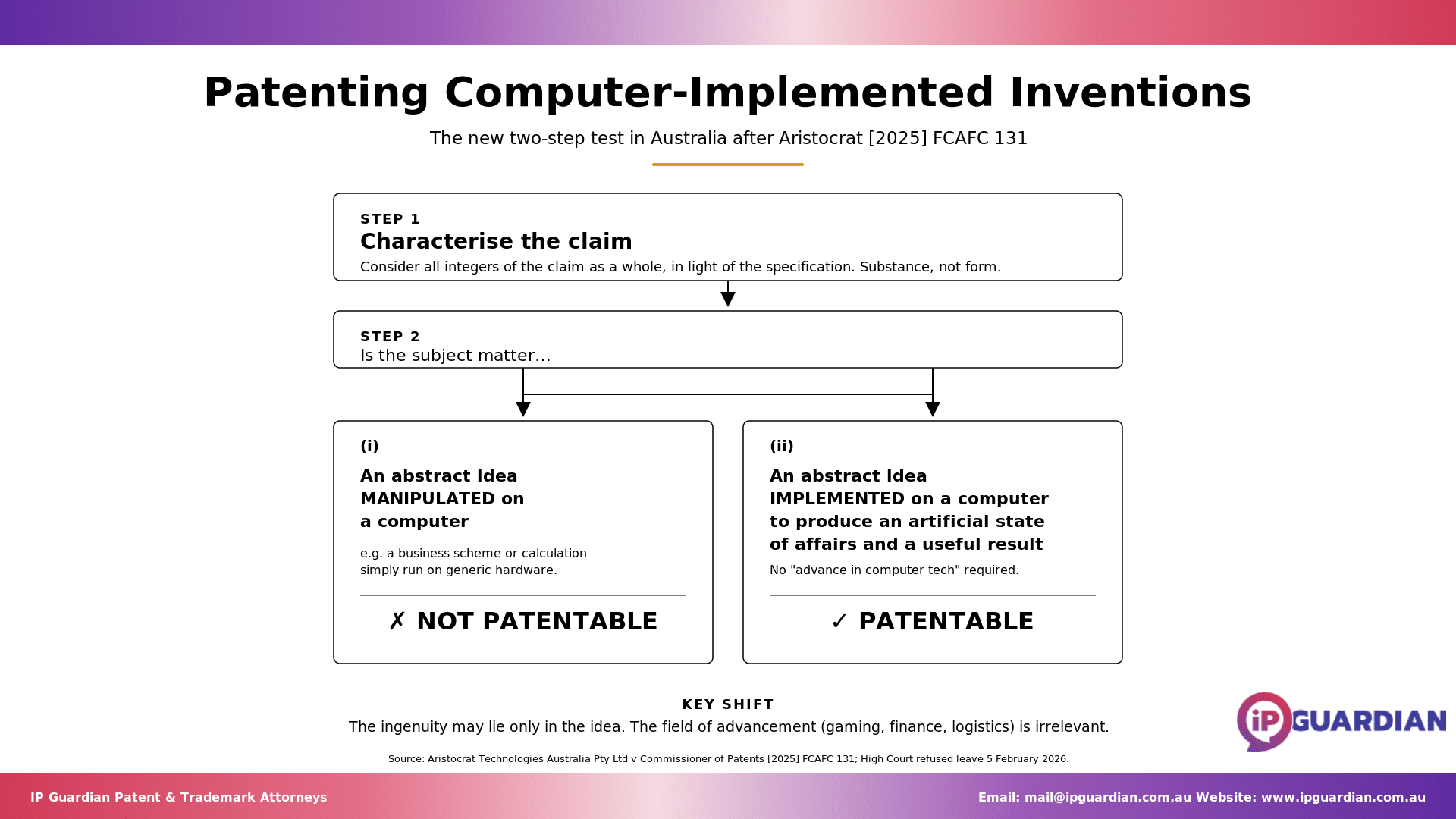
Middleton and Perram JJ (majority) proposed a new two-step alternative approach:
(a) Is the invention claimed a computer-implemented invention? (b) If so, can the invention claimed broadly be described as an advance in computer technology?
Applying this test, their Honours found that while the invention was computer-implemented, it was not an advance in computer technology — only, at most, in gaming technology — and was therefore not patentable subject matter. The matter was remitted to the primary judge for consideration of residual issues.
Nicholas J (minority) declined to follow the two-step approach, preferring to ask whether the invention solved a technical problem or made a technical contribution, whether inside or outside the computer. His Honour found that the specification identified no technological problem and that the purpose of the invention was merely to create a more enjoyable game experience. He agreed with the remittal.
The High Court granted special leave and six Justices heard the appeal. They divided 3-3.
Kiefel CJ, Gageler and Keane JJ (dismissing reasons) held the claims were not a manner of manufacture. Their Honours emphasised that characterisation must be undertaken by reference to the face of the specification, and that in the absence of any adaptation or alteration of computer technology to accommodate the exigencies of the new game, the invention was properly characterised as a claim for a new system or method of gaming — an unpatentable game operated by a wholly conventional computer. They also criticised the majority Full Court's two-step approach as "unnecessarily complicating" the analysis.
Gordon, Edelman and Steward JJ (allowing reasons) held the claims were a manner of manufacture. Their Honours emphasised that characterisation must consider all integers of the claim — not just the inventive aspects — viewed in light of the specification as a whole. They found the Commissioner's characterisation of the invention as a "mere scheme" was achieved only by impermissibly stripping out essential integers, including as basic as the display on which the symbols appeared. Their Honours reformulated the test, rejecting the "advance in computer technology" requirement and substituting the question of whether the subject matter is:
(i) an abstract idea which is manipulated on a computer; or (ii) an abstract idea which is implemented on a computer to produce an artificial state of affairs and a useful result.
All six judges, notably, criticised the Full Court majority's "advance in computer technology" two-step approach.
By operation of s 23(2)(a) of the Judiciary Act 1903 (Cth), the equal division meant the earlier Full Court decision was affirmed. The matter was remitted to Burley J.
On remittal, Burley J was bound to apply the Full Court's majority reasoning. He reluctantly did so and dismissed the appeal. The Full Court in 2025 later described his approach as displaying "self-effacing and restrained" judicial conduct, commending the manner in which he performed his duty "despite what must have been significant misgivings".
Before reaching the merits, Beach, Rofe and Jackman JJ had to resolve a series of intricate precedent questions.
Was the primary judge bound by the earlier Full Court's reasoning? Yes. The earlier Full Court's reasoning, even if criticised by the High Court, had not been formally overruled by a binding majority. The primary judge had no choice but to follow it.
Is the present Full Court bound by the earlier Full Court's reasoning? No. The present Full Court found there was a "compelling reason" to depart from the earlier majority decision: all six High Court Justices had expressly criticised the "advance in computer technology" two-step approach, albeit for different reasons. It would, the Court said, be "perverse" to follow a proposed alternative approach that had been disapproved by every member of the High Court who considered it.
Can the appeal be allowed without finding error by the primary judge? Yes. Drawing on the concept of "constructive error", the Full Court held that in an appeal by way of rehearing, the correctness of the judgment below must be assessed in light of the law as it stands at the time of appeal. Because the Full Court itself was now rejecting the majority reasoning that bound the primary judge, there was a constructive error justifying intervention — even though no criticism of the primary judge was warranted.
Having cleared the procedural thicket, the Full Court turned to the substantive question and adopted the approach set out in the High Court's allowing reasons.
Both sets of High Court reasons agreed that the threshold question is characterisation of the claimed invention — to be decided on a proper construction of the claim in light of the specification as a whole and common general knowledge, and as a matter of substance rather than form.
The Full Court endorsed the characterisation in the allowing reasons as best reflecting the integers of the claim viewed as a whole. The invention was properly characterised as an EGM incorporating an interdependent player interface and game controller, with feature games and configurable symbols that interact with, and are entirely dependent upon, the physical integers of the machine. The configurable symbols — particularly the real-time display of prize values on their faces — were a significant and new enhancement of the player experience at the priority date.
Once properly characterised, the question is whether that subject matter is:
(i) an abstract idea manipulated on a computer; or
(ii) an abstract idea implemented on a computer to produce an artificial state of affairs and a useful result.
The Full Court held the invention fell into category (ii). The EGM as claimed — with its display, credit input mechanism, random number generator, game controller and the interdependent software producing configurable symbols and feature games — produced an artificial state of affairs and a useful result. That result need not be an improvement in computer technology. The ingenuity may lie only in the idea, but when the idea is applied to produce an artificial state of affairs and a useful result, there is a manner of manufacture.
The Court expressly endorsed the analogy deployed in the allowing reasons: if the EGM had been implemented with cogs, physical reels and motors, it would unquestionably have been a manner of manufacture. In the 21st century, a law designed to encourage invention should not reach a different conclusion merely because software and hardware replace mechanical components.
The parties had agreed before the primary judge that if claim 1 of the 967 patent was a manner of manufacture, so were all remaining claims across all four patents. The Full Court applied this agreement. In any event, it separately characterised each residual claim and found each to be an EGM incorporating interdependent physical and software components that produce an artificial state of affairs and a useful result. All were manners of manufacture.
Prior to this decision, the law on computer-implemented inventions had been confused and unstable. Two competing strands of authority had emerged, and the 2021 Full Court exposed the tension between them without resolving it.
The foundational principle was well settled: a mere scheme or business method, even if implemented in a computer, was not a manner of manufacture unless there was something more. The computer had to be "integral to the invention, rather than a mere tool". The leading cases — Grant, Research Affiliates, RPL Central, Encompass and Rokt — all applied this principle to deny patent protection where a scheme was simply "plugged into" a generic computer using its well-known functions.
Where the law was uncertain was in identifying what that "something more" required. Two distinct approaches had developed:
The first strand — advance in computer technology. The 2021 Full Court majority (Middleton and Perram JJ) crystallised the law into an explicit two-step test: a computer-implemented invention was only patentable if it could broadly be described as an advance in computer technology. An invention that advanced gaming technology — or any other field — but not computer technology itself, was not patentable subject matter. This was a narrow test that effectively confined software patent eligibility to innovations in computer science itself.
The second strand — technical solution to a technical problem. A parallel line of authority, reflected in the minority decision of Nicholas J in the 2021 Full Court and drawn from cases such as RPL Central and Konami, asked instead whether the invention solved a technical problem — whether inside or outside the computer — or made a technical contribution in the field of the invention. On this approach, a gaming machine that solved a technical problem in the field of gaming technology could qualify as a manner of manufacture even if it involved no advance in computer technology as such. This was a broader test, but it still demanded an identifiable technical problem and a solution directed to that problem.
Both strands shared a common weakness in the context of this case: both permitted the "inventive concept" to be isolated from the physical integers of the claim before being assessed. Where an invention's purpose was characterised as improving player enjoyment or increasing operator revenue rather than solving a technical problem, neither strand offered a reliable path to patentability.
The 2025 Full Court decision, now settled law following refusal of leave on 5 February 2026, establishes the following principles:
The significance of this shift is substantial.
Under the old law, patent eligibility for software and computer-implemented inventions in Australia had become effectively contingent on proving an advance in computer science. Novel game mechanics, medical diagnostic methods, logistical systems, financial tools and engineering applications — however genuinely inventive — risked being characterised as "mere schemes" if they relied on conventional computers for implementation. The word "computerisation" had become almost a term of art meaning something close to "innovation in computer hardware or architecture".
The new law restores focus to where it belongs: the invention as a whole, properly characterised. If a genuine idea — even a simple one — is implemented through a computer in a way that produces an artificial state of affairs and a useful result in the world, it is capable of being a manner of manufacture. The question is not whether the chips are faster or the memory architecture novel, but whether something has been created that did not exist before, and that has economic utility.
The decisions in Grant, Research Affiliates, RPL Central, Encompass and Rokt are expressly preserved and their results confirmed as correct — but they are now understood on the basis that in each of those cases, the computer was being used merely to manipulate an abstract idea, not to implement it so as to produce an artificial state of affairs and a useful result. The distinction is a meaningful one. A scheme for protecting assets from unsecured creditors (Grant) does not become a manner of manufacture when entered into a computer because the computer merely performs the calculations — no new state of affairs is created beyond the execution of the scheme itself. By contrast, an EGM that produces a new and engaging form of interactive gameplay, with configurable symbols displaying real-time prize values and a feature game mechanic previously unknown in the industry, creates something that did not exist before and produces it through the interdependent operation of hardware and software.
Broader eligibility for software and computer-implemented inventions. Applicants no longer need to demonstrate that their invention represents an advance in computer science or architecture. A novel application of computing to produce a useful real-world result — in gaming, healthcare, logistics, finance, or any other domain — will satisfy the manner of manufacture requirement if the claim is properly constructed to capture the invention as a whole.
Claim drafting remains critical. The emphasis on characterisation means that how a claim is drafted still matters enormously. Claims that are too abstract — stripping out physical or implementation details — risk being characterised as mere ideas manipulated on a computer. Claims that capture the interdependence of hardware, software and output will fare better.
Existing patents should be reviewed. Patent holders in technology-adjacent industries whose patents were previously considered at risk under the "advance in computer technology" standard should reassess their position. Patents covering novel applications of computing that produce genuine real-world effects now have a stronger foundation.
The Commissioner's examination practice will need to align. IP Australia's examination approach to computer-implemented inventions has historically reflected the "advance in computer technology" standard. Examination practice should now align with the correct test as settled by this decision.
Aristocrat Technologies Australia Pty Ltd v Commissioner of Patents [2025] FCAFC 131 is the most important Australian patent decision on software and computer-implemented inventions in many years. It closes a decade of uncertainty, resolves a genuinely difficult precedent situation arising from a 3-3 divided High Court, and articulates a clear and principled test for patent eligibility.
The old law — which demanded an advance in computer technology — was too narrow, anomalous in its results, and inconsistent with the purpose of a patent system designed to encourage invention and innovation. The new law — which asks whether an abstract idea has been implemented on a computer to produce an artificial state of affairs and a useful result — is faithful to the foundational principles of NRDC, consistent with the weight of High Court authority, and workable in practice.
With the High Court's refusal of leave to appeal on 5 February 2026, the law is settled. Australia now has a clear, stable framework for assessing the patentability of computer-implemented inventions — one that rewards genuine innovation wherever it occurs, not merely innovation in computer science itself.
This article is intended as a general summary of the law for informational purposes. It does not constitute legal advice. Readers should seek independent legal advice in relation to specific patent matters.

Mike Biagio has had previous experience in research and development and project engineering before becoming a patent attorney. Mike has been involved in specialist intellectual property law since 2001 in a variety of countries including South Africa, New Zealand and Australia, and has more than 21 years of experience as a patent attorney in obtaining patents and designs around the world for his clients.
Mike has been a lecturer and regular mentor at UNSW, University of Wollongong, and University of Sydney for a number of years, and has advised start-ups at incubators/accelerators on intellectual property and ideation.


I found them online and initially I was bit hesitant to talk to them about my problem but when I spoke to Barry, I felt more comfortable, and he gave me all the information and advice I wanted without even thinking that I am going to give him business or not. Finally, I went with them, and they made the entire process so smooth and easy for me. john was keeping us updated with each step he was doing. I would recommend these guys for any patent or trademark related service.

I would like to express my thanks to Barry and his team at IP Guardian in Sydney for their assistance with our recent Trademark application. Barry was highly professional, readily available throughout the process and clearly communicated expectations. Barry even helped us refine our application so that we had a greater chance of success which was very much appreciated to avoid extra costs. I would highly recommend Ip Guardian for all your Trademark and Intellectual Property needs.

Barry, last week, you and your professional team, made my year (or probably my next 21 years). So thank you so much for your executive, calm yet very effective actions under extream pressure. Elias Hajjar, Director, TROLLEYON PTY LTD

Informative, understood the business, what it needed and answered questions in a friendly and approachable manner. Easy decision to continue working with IPGuardian for future trademarking

From the day I contacted Barry Meskin until now with my silly amateur questions, he has been nothing short of amazing. I actually NEVER leave reviews anywhere, but I felt the need to do so for Barry and his team. I myself am a tradie, so I felt intimidated speaking to an attorney. But the second I spoke to him on the phone, he made me feel right at home. Never pressured me into any decisions, yet when I decided to go ahead with him, he delivered what I needed much quicker than what I was expecting. I cannot speak highly enough of him and recommend his services 100%.

The team at IP Guardian have made the process extremely straight forward and easy for us to understand exactly what was required. I will highly recommend to our clients who need help with IP.

I have dealt with Barry over the years, his advice and experience has helped me greatly. Looking for to working with him and his team again. Maher.

IP Guardian helps protect words, symbols, letters, numbers, names, signatures, phrases, sounds, shapes and smells. Yes, I said smells.

We've had the pleasure to work closely with Barry for many years. He has been exceptional to deal with and has a keen focus in providing a commercial led IP "go to market" strategy for start-ups and well known brands. Makes it easy and always advises on different ways to navigate through the IP process.

Barry Meskin @ IP Guardian is an experienced and extremely knowledgeable expert in the domain of intellectual property, patents and trademarks. In addition he has been extremely responsive and very professional in all our dealings. I wholeheartedly recommend Barry's services to any business or anyone seeking advice in this area - great quality and great value.