The landscape is about to change. The Riyadh Design Law Treaty (RDLT), finalised in 2024 under the World Intellectual Property Organization (WIPO), aims to make international design registration simpler, cheaper and more predictable. This new global framework could mark the most significant shift in design law in decades, and Australian creatives should be paying attention.
The Riyadh Design Law Treaty was adopted by WIPO member states in November 2024. Its goal is to harmonise procedural requirements for registering industrial designs, making it easier for designers to obtain protection in multiple countries through a consistent set of rules.
The treaty focuses on formalities, not on the underlying rules about what makes a design new or distinctive. In practice, it sets out a standardised list of what information and materials a designer must provide when filing an application. This clarity removes a major source of confusion for those seeking protection abroad.
Other key features include:
The treaty will come into force once at least fifteen countries ratify it, and the expectation is that this will happen within the next few years. Australia has not yet indicated that it will ratify the treaty and IP Australia has said that the next step for Australia is consideration by the Australian Government on whether joining is in Australia’s national interest.
Under the current system, Australian designers face a maze of rules when trying to register their work overseas. Each country has different application requirements, forms and deadlines. Missing one detail can delay or derail an entire filing.
The Riyadh Treaty introduces a single set of standardised formalities that all participating countries must follow. This means Australian designers will be able to file abroad with far greater confidence that their application will meet each country’s requirements.
Equally important is the treaty’s alignment with the digital age. It encourages national offices to accept electronic submissions and digital design files, making it easier for designers to file online from anywhere. For creative professionals used to working with 3D renderings, video prototypes, or virtual reality visualisations, this update is long overdue.
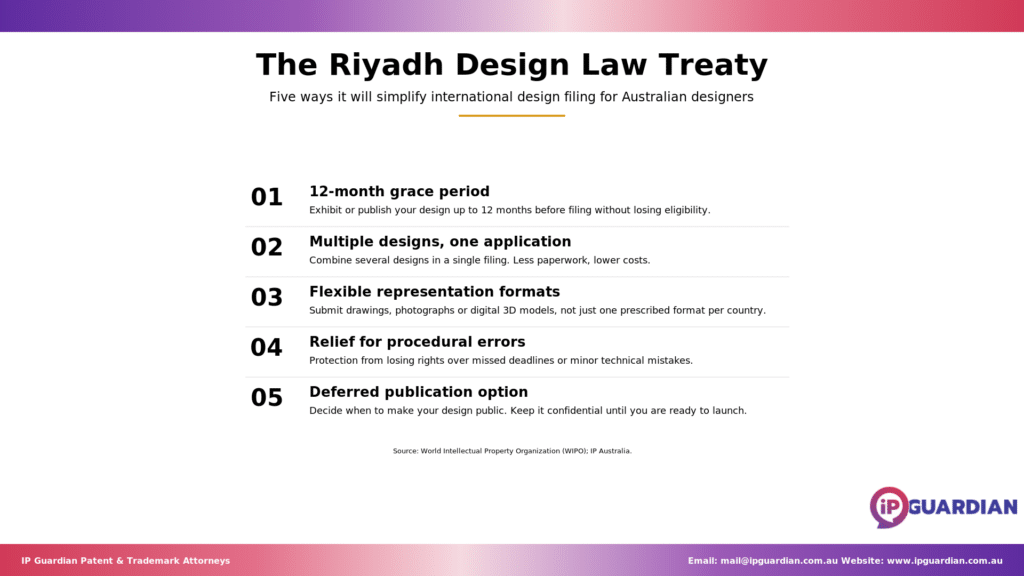
The sectors likely to benefit most from this reform are the ones where visual design is central to commercial value. Furniture makers, fashion houses, consumer electronics brands and industrial designers all rely heavily on aesthetics to set their products apart.
Small and medium-sized enterprises (SMEs) stand to gain the most. For years, the cost and complexity of international filings have been barriers to entry for smaller firms. With the Riyadh Treaty streamlining formalities, it should become easier and more affordable for Australian creators to protect their products overseas.
The design economy in Australia is already significant. According to IP Australia’s latest figures, more than 7,000 design applications are filed each year, and creative industries contribute more than $111 billion to the national economy. A more accessible global system could amplify that impact by helping Australian designs reach wider markets with proper legal safeguards.
Although Australia has not yet ratified the Riyadh Treaty, it is expected that the government will consider doing so in the coming years. If adopted, local legislation and procedures will need to be updated to align with the treaty’s framework.
Changes may include:
Australia has historically been proactive in adopting international IP reforms. Ratifying the Riyadh Treaty would be a logical next step to support Australian designers in global markets.
While the treaty promises simplification, it will not solve every problem. The RDLT standardises procedures, but it does not change substantive design law. Each country will still determine what qualifies as a design and what level of originality is required.
Some countries may also choose to opt out of certain treaty provisions, creating variations in implementation. Designers will still need expert advice to navigate overlapping jurisdictions and understand which rights apply where.
There is also the question of timing. Even after ratification, it may take several years for countries to update their domestic laws and digital systems. During that period, businesses will need to manage both old and new filing processes.
At IP Guardian, we work with Australian designers, brands and manufacturers to protect their visual assets both locally and internationally. Our attorneys understand the nuances of design registration and how upcoming reforms like the Riyadh Treaty will reshape the landscape.
Our expertise covers:
By staying ahead of international changes, IP Guardian positions its clients to benefit from new opportunities as soon as they arise.
The Riyadh Design Law Treaty represents an important step toward a more coherent global design system. For Australia, it could reduce red tape, lower costs and strengthen the competitiveness of local design industries.
In the short term, designers should focus on understanding their current protections and building robust filing strategies that can transition smoothly into the new regime. Over time, as Australia and other nations implement the treaty, cross-border design protection should become more efficient, transparent and accessible than ever before.
The ability to protect visual innovation globally is vital for a country like Australia, where creativity and design excellence are key export strengths. The Riyadh Design Law Treaty promises to make that process easier and fairer.
As the world moves toward harmonised design systems, working with experienced advisors will be essential. IP Guardian is ready to help Australian designers understand what the treaty means for them and how to take full advantage of these global reforms.
To learn more or to discuss your design strategy, let’s chat.


Mike Biagio has had previous experience in research and development and project engineering before becoming a patent attorney. Mike has been involved in specialist intellectual property law since 2001 in a variety of countries including South Africa, New Zealand and Australia, and has more than 21 years of experience as a patent attorney in obtaining patents and designs around the world for his clients.
Mike has been a lecturer and regular mentor at UNSW, University of Wollongong, and University of Sydney for a number of years, and has advised start-ups at incubators/accelerators on intellectual property and ideation.


I found them online and initially I was bit hesitant to talk to them about my problem but when I spoke to Barry, I felt more comfortable, and he gave me all the information and advice I wanted without even thinking that I am going to give him business or not. Finally, I went with them, and they made the entire process so smooth and easy for me. john was keeping us updated with each step he was doing. I would recommend these guys for any patent or trademark related service.

I would like to express my thanks to Barry and his team at IP Guardian in Sydney for their assistance with our recent Trademark application. Barry was highly professional, readily available throughout the process and clearly communicated expectations. Barry even helped us refine our application so that we had a greater chance of success which was very much appreciated to avoid extra costs. I would highly recommend Ip Guardian for all your Trademark and Intellectual Property needs.

Barry, last week, you and your professional team, made my year (or probably my next 21 years). So thank you so much for your executive, calm yet very effective actions under extream pressure. Elias Hajjar, Director, TROLLEYON PTY LTD

Informative, understood the business, what it needed and answered questions in a friendly and approachable manner. Easy decision to continue working with IPGuardian for future trademarking

From the day I contacted Barry Meskin until now with my silly amateur questions, he has been nothing short of amazing. I actually NEVER leave reviews anywhere, but I felt the need to do so for Barry and his team. I myself am a tradie, so I felt intimidated speaking to an attorney. But the second I spoke to him on the phone, he made me feel right at home. Never pressured me into any decisions, yet when I decided to go ahead with him, he delivered what I needed much quicker than what I was expecting. I cannot speak highly enough of him and recommend his services 100%.

The team at IP Guardian have made the process extremely straight forward and easy for us to understand exactly what was required. I will highly recommend to our clients who need help with IP.

I have dealt with Barry over the years, his advice and experience has helped me greatly. Looking for to working with him and his team again. Maher.

IP Guardian helps protect words, symbols, letters, numbers, names, signatures, phrases, sounds, shapes and smells. Yes, I said smells.

We've had the pleasure to work closely with Barry for many years. He has been exceptional to deal with and has a keen focus in providing a commercial led IP "go to market" strategy for start-ups and well known brands. Makes it easy and always advises on different ways to navigate through the IP process.

Barry Meskin @ IP Guardian is an experienced and extremely knowledgeable expert in the domain of intellectual property, patents and trademarks. In addition he has been extremely responsive and very professional in all our dealings. I wholeheartedly recommend Barry's services to any business or anyone seeking advice in this area - great quality and great value.