In today’s world of generative AI, machine learning and autonomous systems, one of the hottest legal questions is this: can an AI be listed as an inventor on a patent? The idea sounds futuristic, but it has already played out in courtrooms, legislatures and patent offices. In Australia, that debate has sharpened significantly.
Let’s explore how the law views AI inventorship, the key cases that have shaped the rule and how IP Guardian helps clients navigate this uncharted territory.
Imagine a powerful algorithm that independently conceives a novel drug, a new battery material, or an optimised mechanical structure without explicit human direction. If patent law allows AI to be inventor, it would radically shake how we reward creativity, assign ownership and drive investment.
Patents are incentives. They reward those who make the inventive leap. If AI starts making those leaps, the whole system must rethink who gets credit, who pays and who enforces rights. That makes this more than academic. It is foundational to technology policy, innovation strategy and business planning.
Under Australian law, the concept of an inventor is rooted in the idea of a person who devises or contributes to a new invention. The Patents Act 1990 (Cth) and relevant regulations have long assumed that inventors are natural persons.
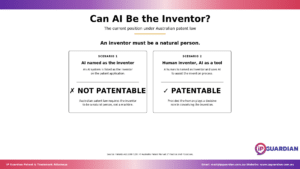
IP Australia’s manuals make this clear: “an inventor must be a natural person and cannot be a legal recognised entity such as a corporation, or Artificial intelligence.”.
That assumption was tested in the famous Thaler / DABUS saga. Dr Stephen Thaler applied for patents naming an AI system called DABUS as the inventor, claiming the AI had autonomously generated the invention. The Deputy Commissioner initially rejected the application for failing to name a human inventor.
Some stunned observers looked on with interest when, in 2021, Justice Beach, a Federal Court judge, found that the term “inventor” might be interpreted more flexibly, potentially allowing a machine to be inventor under certain readings of the statute. But that was not the end.
In 2022, the Full Federal Court unanimously reversed that view in Commissioner of Patents v Thaler, reaffirming that an inventor must be a human (or group of humans). The court emphasised that in Australia’s statutory structure, invention attribution must be to persons.
Dr Thaler sought appeal to the High Court, but his application for special leave was refused in November 2022. That refusal effectively locked in that AI cannot be an inventor under current Australian law.
Thus, the prevailing rule in Australia today is: you cannot list an AI as the inventor.
Australia is not alone in wrestling with this question. Many jurisdictions maintain the stance that only humans can be inventors, including the U.S., the European Patent Office and the UK.
Some intrigue surrounds jurisdictions like South Africa where patent offices granted rights listing AI as inventor (with human beneficiaries). Yet even in those cases, thorny issues of ownership, liability and accountability loom large.
In Australia, one interesting nuance is that while the inventor must be human, inventions that result from AI use or AI assistance can still be patentable, provided a human played a decisive role in conception or implementation. The courts and IP Australia require clarity about human “inventive concept” contributions.
The rise of generative AI, large language models and self-optimising systems stirs policy discussions about how IP law might adapt. Some observers look to the Artificial Inventor Project, a campaign pushing test cases in multiple countries to force law reform to recognise nonhuman inventors.
Several deep challenges lie at the heart of the debate:
These tensions mean that, despite excitement, reform will not be simple or immediate.
At IP Guardian, we believe the AI inventorship debate is not just an academic point. It has real consequences for innovators building in biotech, clean energy, software, and more. Here’s how we help clients:
Because the debate continues to evolve, having a partner who understands both IP law and emerging technology is vital. IP Guardian is here for you.
While the current law in Australia bars AI from being inventor, change is not inconceivable. As AI systems become more autonomous, pressure will build for law reform, statutory updates, or regulatory adaptation. We expect to see:
For Australian innovators, the message is clear: protect what you can now, but keep an eye on how this frontier evolves.
The question “Can artificial intelligence be an inventor?” touches the heart of how we reward innovation. In Australia, the law currently says inventors must be human. The DABUS case reinforced that position, and the Full Court’s ruling has held firm. Yet the pace of AI development makes this a live topic, not a closed one.
At IP Guardian, we help inventors and organisations navigate these uncertainties. Whether your innovation includes AI, machine learning, or autonomous systems, we make sure your patent strategy is robust, forward-looking, and ready to adapt.
Curious how AI, patents, and your industry intersect? Reach out to our IP Guardian team for a consultation. We’re happy to explore possibilities with you.

Registered Patent and Trade Mark Attorney with significant experience obtaining all forms of registered intellectual property. I hold a Bachelor of Science in Engineering, a Masters of Business Administration and a Masters of Intellectual Property. I’m passionate about showing my clients how they can protect their brands through trademark registrations.


I found them online and initially I was bit hesitant to talk to them about my problem but when I spoke to Barry, I felt more comfortable, and he gave me all the information and advice I wanted without even thinking that I am going to give him business or not. Finally, I went with them, and they made the entire process so smooth and easy for me. john was keeping us updated with each step he was doing. I would recommend these guys for any patent or trademark related service.

I would like to express my thanks to Barry and his team at IP Guardian in Sydney for their assistance with our recent Trademark application. Barry was highly professional, readily available throughout the process and clearly communicated expectations. Barry even helped us refine our application so that we had a greater chance of success which was very much appreciated to avoid extra costs. I would highly recommend Ip Guardian for all your Trademark and Intellectual Property needs.

Barry, last week, you and your professional team, made my year (or probably my next 21 years). So thank you so much for your executive, calm yet very effective actions under extream pressure. Elias Hajjar, Director, TROLLEYON PTY LTD

Informative, understood the business, what it needed and answered questions in a friendly and approachable manner. Easy decision to continue working with IPGuardian for future trademarking

From the day I contacted Barry Meskin until now with my silly amateur questions, he has been nothing short of amazing. I actually NEVER leave reviews anywhere, but I felt the need to do so for Barry and his team. I myself am a tradie, so I felt intimidated speaking to an attorney. But the second I spoke to him on the phone, he made me feel right at home. Never pressured me into any decisions, yet when I decided to go ahead with him, he delivered what I needed much quicker than what I was expecting. I cannot speak highly enough of him and recommend his services 100%.

The team at IP Guardian have made the process extremely straight forward and easy for us to understand exactly what was required. I will highly recommend to our clients who need help with IP.

I have dealt with Barry over the years, his advice and experience has helped me greatly. Looking for to working with him and his team again. Maher.

IP Guardian helps protect words, symbols, letters, numbers, names, signatures, phrases, sounds, shapes and smells. Yes, I said smells.

We've had the pleasure to work closely with Barry for many years. He has been exceptional to deal with and has a keen focus in providing a commercial led IP "go to market" strategy for start-ups and well known brands. Makes it easy and always advises on different ways to navigate through the IP process.

Barry Meskin @ IP Guardian is an experienced and extremely knowledgeable expert in the domain of intellectual property, patents and trademarks. In addition he has been extremely responsive and very professional in all our dealings. I wholeheartedly recommend Barry's services to any business or anyone seeking advice in this area - great quality and great value.