Artificial intelligence tools are now part of the world at work. AI is being used by startups, researchers and SMEs to move faster and do more with fewer resources, replacing hours and hours of mind-numbing repetitive labour. In the patent space, however, this convenience comes with serious legal risks that are not always obvious at the time of use.
For Australian inventors and businesses, understanding how AI interacts with patent law is now essential. Used carefully, AI can support innovation. Used carelessly, it can destroy confidentiality, weaken patent rights, or even make an invention unpatentable altogether.
Recent guidance from The Chartered Institute of Patent Attorneys in the UK highlights just how high the stakes are when AI tools intersect with patents. Let’s take a deep dive into the risks and safeguards for inventors and SMEs.
To speak to a patent lawyer about the risks of AI, get in touch with IP Guardian. We are on the ground floor of using AI in all industries, and can help you institutionalise safe practices for using artificial intelligence.
AI tools can be helpful in early-stage research, problem solving and administrative work. Some patent professionals use carefully controlled AI systems to assist with background searches or internal workflows. Patent offices themselves are also exploring AI to improve search efficiency.
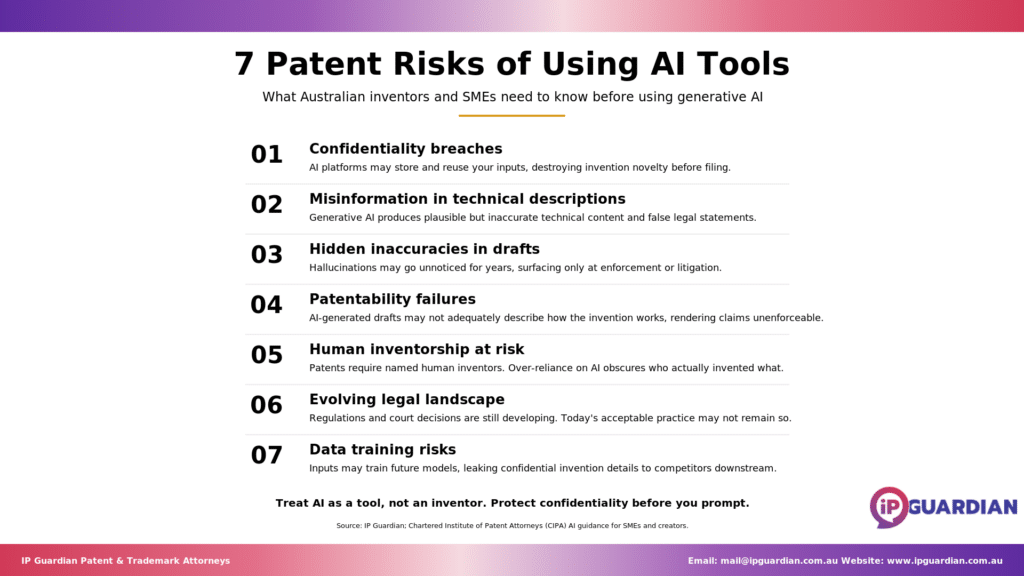
The problem arises when generative AI tools are used without safeguards. Many widely available language models are not designed for confidential or legally sensitive work. Information entered into these tools may be stored, reused, or treated as publicly disclosed.
For patent law, confidentiality before filing is critical. Once an invention is disclosed to the public, even unintentionally, patent rights may be lost in Australia and in many overseas jurisdictions.This means if you disclose your invention to AI tools, it could be considered a public disclosure.
AI tools are designed to produce convincing language, not guarantee accuracy. This creates a real risk of misinformation in patent work.
Generative AI can produce technical descriptions that sound plausible but are incorrect, incomplete, or based on false assumptions. It may invent features, misstate how an invention works, or misunderstand prior art.
Legal concepts such as inventorship or patent requirements may also be presented inaccurately.
AI tools can create serious confidentiality risks when used in connection with inventions.
Terms and conditions of AI platforms may change without notice. Some tools reserve the right to utilise user inputs as training data, which can result in permanent exposure of confidential information.
Once confidential invention details are shared, trade secrets may effectively enter the public domain. In a patent context, this can destroy novelty and make the invention unprotectable.
For inventors and SMEs, this risk arises even where disclosure is unintended or misunderstood.
AI tools can generate content that appears credible but contains critical errors.
These systems are known to produce hallucinations and plausible sounding technical or legal statements that are not correct. In patent documents, these inaccuracies may go unnoticed for years.
Problems often only surface during patent enforcement, opposition, or litigation, when it is too late to fix them.
Reliance on AI generated content without expert verification can result in weak or invalid patent rights.
AI tools may generate patent applications that look complete but fail to meet legal requirements.
In particular, AI generated drafts may not properly describe how the invention works or how it can be carried out. This can result in patents that are invalid or impossible to enforce.
A patent that does not adequately disclose the invention provides little or no real protection, regardless of how polished the application appears.
Patents require named human inventors.
Over reliance on AI tools can make it difficult to identify human contributions to an invention. This creates risk around inventorship, ownership, and future enforcement.
If inventorship is incorrect or unclear, a patent may be vulnerable to challenge or revocation, even years after it is granted.
Clear identification of human inventive input is essential under Australian patent law.
The legal framework around AI and intellectual property is still developing.
New regulations or court decisions may apply to patent applications filed today, creating unforeseen complications in the future.
In addition, the terms and conditions of many AI tools expressly prevent their use for legal advice or regulated professional services, which may create compliance issues for businesses relying on AI in patent work.
What is acceptable practice today may not remain so tomorrow.
In many cases, information entered into AI tools may be used to train future models.
This means confidential technical details could contribute to future AI outputs, potentially benefiting competitors.
There is also a risk that models trained on copyrighted material may generate corresponding output, creating additional legal exposure for users.
For inventors and SMEs, this raises serious concerns about loss of competitive advantage and downstream IP liability.
At IP Guardian, we work closely with Australian inventors and SMEs navigating the challenges of AI and intellectual property. We understand how AI tools are being used in real-world innovation and where the legal fault lines lie.
Our approach focuses on:
We also stay across international developments, recognising that many Australian innovators operate globally and need protection that stands up beyond Australia.
AI is not going away, and neither are the legal questions it raises. Regulators, courts and patent offices around the world are continuing to refine their approach to AI and intellectual property.
For now, the safest path for Australian inventors and SMEs is a cautious one. Treat AI as a tool, not an inventor. Protect confidentiality rigorously. Seek professional advice before relying on AI-generated content in patent work.
With the right safeguards in place, AI can support innovation rather than undermine it.
If you are using AI tools as part of your invention or product development process and want to understand how to protect your intellectual property, speaking with an experienced patent attorney early can make all the difference. IP Guardian is here to help you do that with clarity and confidence.

Registered Patent and Trade Mark Attorney with significant experience obtaining all forms of registered intellectual property. I hold a Bachelor of Science in Engineering, a Masters of Business Administration and a Masters of Intellectual Property. I’m passionate about showing my clients how they can protect their brands through trademark registrations.


I found them online and initially I was bit hesitant to talk to them about my problem but when I spoke to Barry, I felt more comfortable, and he gave me all the information and advice I wanted without even thinking that I am going to give him business or not. Finally, I went with them, and they made the entire process so smooth and easy for me. john was keeping us updated with each step he was doing. I would recommend these guys for any patent or trademark related service.

I would like to express my thanks to Barry and his team at IP Guardian in Sydney for their assistance with our recent Trademark application. Barry was highly professional, readily available throughout the process and clearly communicated expectations. Barry even helped us refine our application so that we had a greater chance of success which was very much appreciated to avoid extra costs. I would highly recommend Ip Guardian for all your Trademark and Intellectual Property needs.

Barry, last week, you and your professional team, made my year (or probably my next 21 years). So thank you so much for your executive, calm yet very effective actions under extream pressure. Elias Hajjar, Director, TROLLEYON PTY LTD

Informative, understood the business, what it needed and answered questions in a friendly and approachable manner. Easy decision to continue working with IPGuardian for future trademarking

From the day I contacted Barry Meskin until now with my silly amateur questions, he has been nothing short of amazing. I actually NEVER leave reviews anywhere, but I felt the need to do so for Barry and his team. I myself am a tradie, so I felt intimidated speaking to an attorney. But the second I spoke to him on the phone, he made me feel right at home. Never pressured me into any decisions, yet when I decided to go ahead with him, he delivered what I needed much quicker than what I was expecting. I cannot speak highly enough of him and recommend his services 100%.

The team at IP Guardian have made the process extremely straight forward and easy for us to understand exactly what was required. I will highly recommend to our clients who need help with IP.

I have dealt with Barry over the years, his advice and experience has helped me greatly. Looking for to working with him and his team again. Maher.

IP Guardian helps protect words, symbols, letters, numbers, names, signatures, phrases, sounds, shapes and smells. Yes, I said smells.

We've had the pleasure to work closely with Barry for many years. He has been exceptional to deal with and has a keen focus in providing a commercial led IP "go to market" strategy for start-ups and well known brands. Makes it easy and always advises on different ways to navigate through the IP process.

Barry Meskin @ IP Guardian is an experienced and extremely knowledgeable expert in the domain of intellectual property, patents and trademarks. In addition he has been extremely responsive and very professional in all our dealings. I wholeheartedly recommend Barry's services to any business or anyone seeking advice in this area - great quality and great value.